

Starting Firdapse
Optimal dosing starts with titration
Titration is a process that uses step-by-step increases to reach the right dose for you. During titration, your doctor will establish a plan to steadily increase your dose over the first few weeks. While this process is typical for FIRDAPSE, your doctor may decide that you do not need to titrate.
Here’s how it often works for patients 6 years or older and weighing 45 kg or more*:
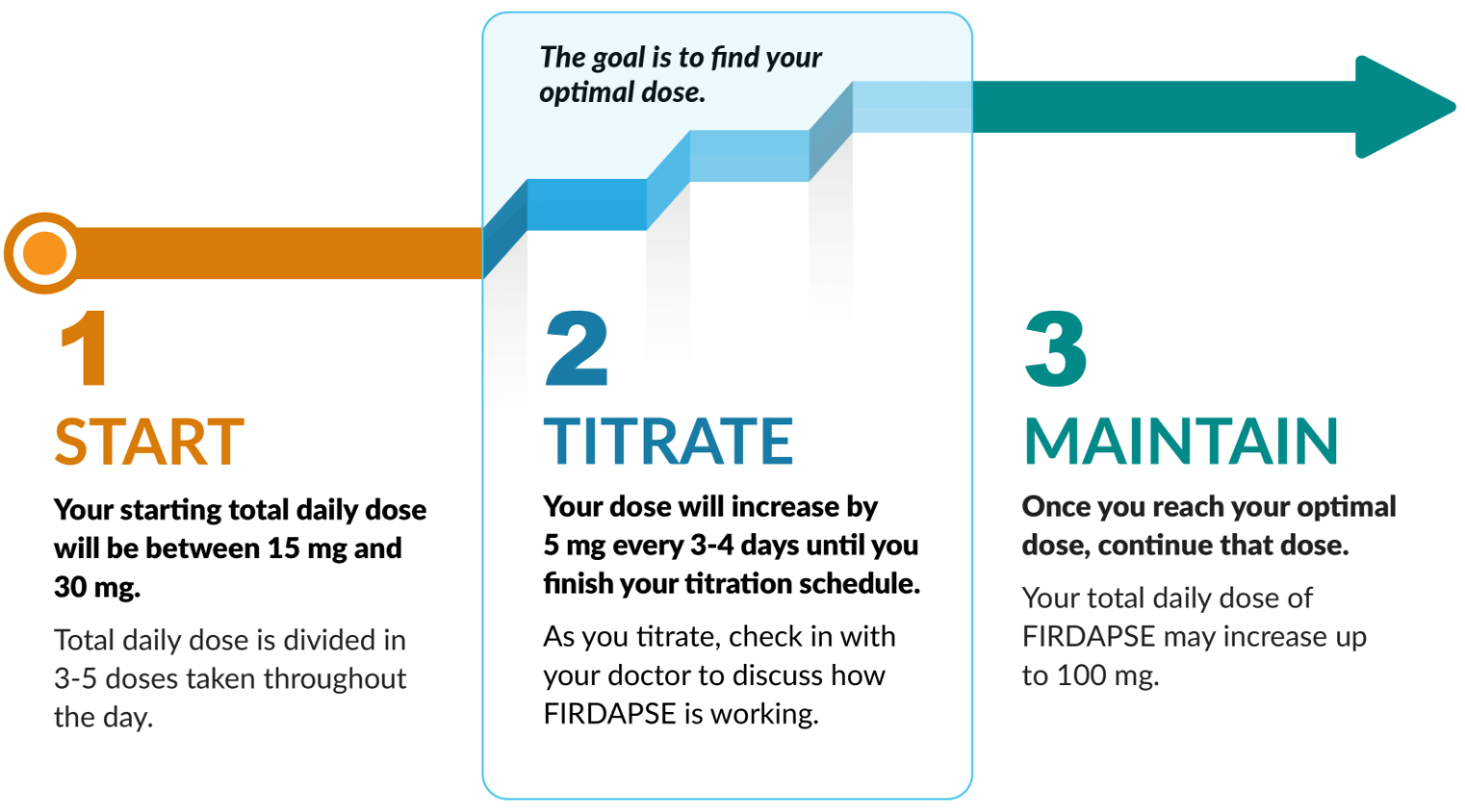
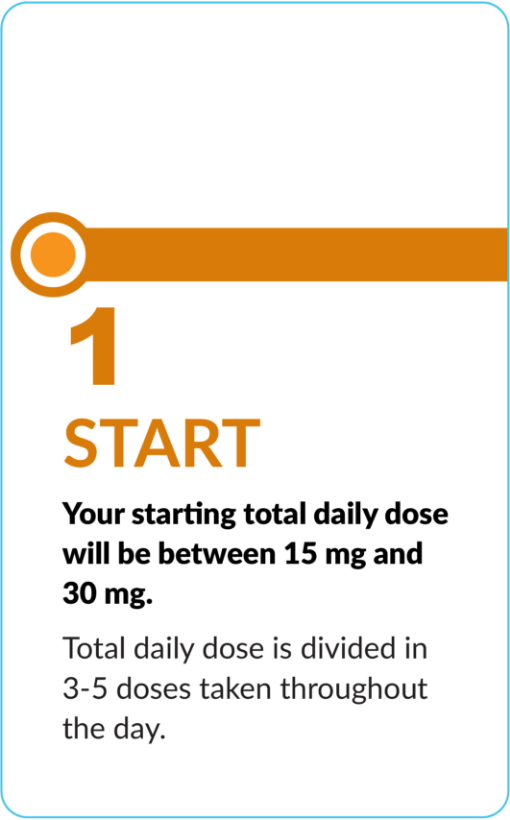
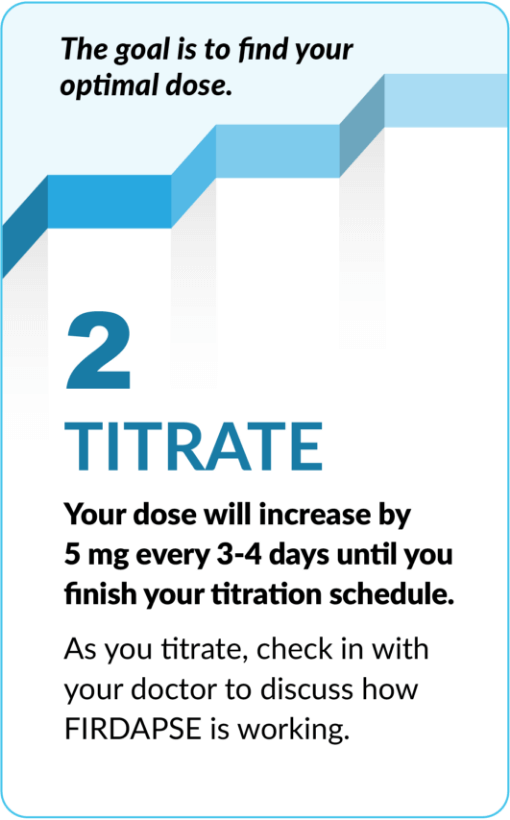
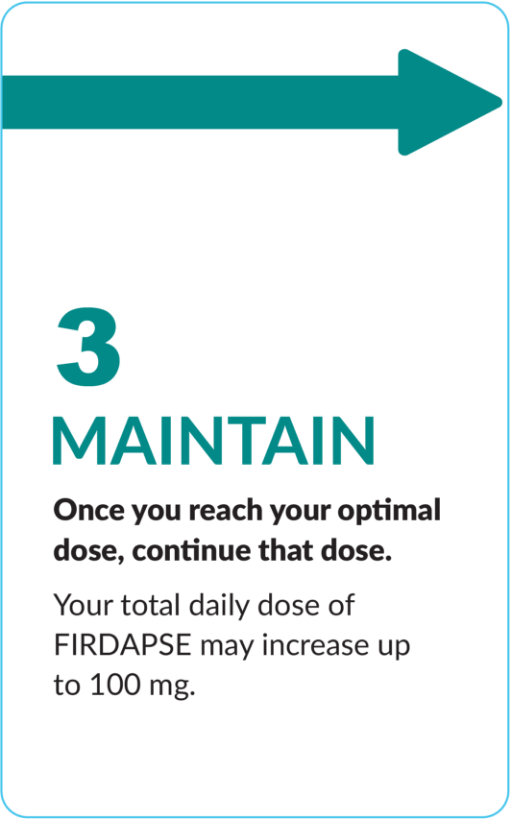
Swipe or tap arrows to see steps.
Always follow the schedule provided by your doctor and pharmacist.
See FIRDAPSE dosing information for pediatric patients.



Titration is a process,
and it can look different for everyone
Some people may experience a rapid improvement in their symptoms when treated with FIRDAPSE. For others, it may take longer to reach their optimal dose. It’s normal to keep adjusting—finding your optimal dose can take time.
THE TIME TO REACH YOUR OPTIMAL DOSE depends on the titration schedule your doctor has outlined for you and how you respond to FIRDAPSE. Be sure to follow their instructions closely.
Here’s what a sample titration schedule can look like in adults and pediatric patients 6 years or older and weighing 45 kg or more*:

Start at 10 mg, 3 times a day.

Increase by 5 mg every 4 days.
As you gradually increase your dose, check in with your doctor to discuss how it’s working.
The average total daily dose in clinical trials was about 60 mg.
Dosing has been approved up to 100 mg a day.
*The recommended starting dosage for adult and pediatric patients with kidney impairment, liver impairment, and in poor metabolizers of N-acetyltransferase 2 (NAT2) is the lowest recommended initial dosage (15 mg daily in adults and in pediatric patients weighing 45 kg or more; 5 mg daily for pediatric patients weighing less than 45 kg). This dose should continue to be titrated to optimal symptom management and tolerability. No dosage recommendation for FIRDAPSE can be made for patients with end-stage kidney disease.

REMINDERS ABOUT SIDE EFFECTS
- One of the most common side effects with FIRDAPSE is tingling around the mouth, tongue, face, fingers, toes, and other body parts, also known as paresthesia. These may go away over time. These are not all the possible side effects of FIRDAPSE
- Tell your doctor if you have any side effect that bothers you or does not go away
- See the Important Safety Information for more information
TRACK AS YOU GO
Use the “My Health Journal” provided by your Patient Access Liaison (PAL) to record symptoms or side effects you notice as you’re titrating.
Stick to your schedule
It’s important to follow your prescription carefully. Take FIRDAPSE exactly as prescribed.
- FIRDAPSE is taken 3 to 5 times per day, with or without food
- For patients 6 years or older and weighing 45 kg or more, the maximum single dose is 20 mg

If your dose is less than 5 mg, you have trouble swallowing tablets, or a feeding tube is needed, see the detailed Instructions for Use on how to take and prepare a suspension of FIRDAPSE.
You may need to split your FIRDAPSE pills in half
FIRDAPSE COMES IN 10-MG TABLETS, but it’s possible for your schedule to require smaller increments. That’s why FIRDAPSE tablets are prescored to make them easy to split.
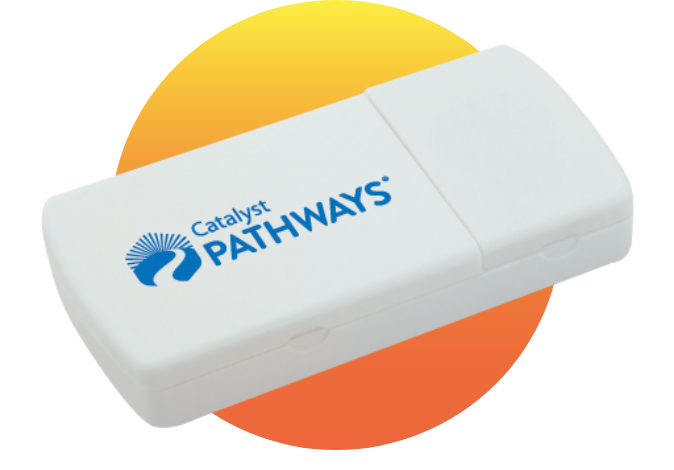
Follow your doctor’s instructions carefully—they will work with you to find the right dose for you. A pill cutter is provided in the FIRDAPSE welcome kit or by your PAL when you join Catalyst Pathways. It is not required to use the pill cutter.


Go to the Patient Stories page to watch real LEMS patients talk about their treatment experiences with FIRDAPSE.

Have a live, 1-on-1 phone call with a LEMS patient who’s been in your shoes. Call 1-833-492-8853 or click the link below.